Concrete Coating Removal: How Grinding Preps a Floor for a New Finish
The tiles are gone. The carpet is out on the nature strip. What is left is a slab covered in hardened glue ridges, flaking paint and a patchy grey film that used to be a coating. It looks close to finished. It is not.
That slab is the foundation of every dollar the new floor is about to cost, and whatever is still stuck to it decides how the new finish performs. Turning that contaminated surface back into sound concrete is where concrete coating removal comes in, and it's the step most people underestimate before the machines arrive.
Here is what actually has to come off, why it matters more than it looks like it should, and how grinding does the job properly.
What Concrete Coating Removal Actually Involves
It is the mechanical stripping of paint, tile adhesive, epoxy, sealers, glues and other bonded material off a slab so a new finish can bond to clean, sound concrete underneath. In most cases, it is done by grinding, because a grinder takes off the contaminant and a thin layer of the concrete surface with it, leaving solid material rather than a tidied-up contaminated layer.
We are Coulson's Concrete Finishes, and stripping slabs back is the first stage of most jobs we take on across the Gold Coast, Brisbane and Northern NSW. Our concrete grinding and surface preparation service covers everything from a single garage through to full commercial fit-outs, and the same principle applies at every scale: the new floor is only ever as good as the surface it is bonded to.
Removing Tile Glue From Concrete Is Rarely the Whole Job

Lift an old floor covering, and you almost never find one thing underneath. You find layers, and each one behaves differently under a machine.
What we routinely uncover on a renovation slab:
- Cement-based tile adhesive, often with the bedding or screed still attached
- Older mastics and pressure-sensitive glues from the floor before that one
- Carpet and vinyl adhesive, usually in long dried ribbons
- Painted concrete, sometimes with a coating that was never meant for a floor
- Failed epoxy, lifting at the edges and stubbornly bonded in the middle
- Sealers that stay invisible until a grinder touches them
- Waterproofing membrane in bathrooms, laundries and balconies
- Levelling compound poured over a problem someone else decided not to fix
A slab in a 1980s home can carry three or four generations of flooring stacked on top of each other. A retail tenancy that has changed hands twice can carry more.
Why the Material Type Changes Everything
Identifying what is on the slab is not a formality: it is the decision the whole job rests on. Hard cement-based adhesive fractures and lifts off in chunks. Soft mastics smear, clog tooling and slow everything down. Thick epoxy needs aggressive tooling from the start. Thin acrylic paint can glaze over and burn into the surface if the wrong approach is used.
This is why two quotes on the same floor can look nothing alike. One contractor has worked out what is there. The other has quoted a square metre rate and hoped.
Why Leftover Coatings Ruin a New Floor
The failures that come from incomplete preparation are predictable, and we see the same handful over and over.
A new coating that cannot key into the concrete will bubble, peel or delaminate once the floor goes into service, sometimes within months. Adhesive ridges left proud of the surface telegraph straight through vinyl planks and hybrid flooring, showing as lines across a floor that was meant to be flat. High spots stop a new tile bed from sitting level. On anything polished or sealed, patches of old glue absorb stain differently from the concrete around them, which shows as blotching that cannot be fixed.
Then there is laitance, the weak layer of fine cement particles that bleed water carries to the surface as a slab cures. It looks like sound concrete, but it has almost no strength. A coating bonded to laitance is bonded to something that will let go, which is why grinding past it matters as much as removing what sits on top of it. Trapped moisture is another common culprit, and it deserves its own conversation. For a deeper look at the common causes of coating failure and the preparation that helps prevent callbacks, see [Future cluster post: "Why Floor Coatings Fail: Moisture, Laitance and the Prep That Prevents Callbacks", link when live].
None of this is an argument for doing more work than a floor needs. It is worth knowing when a concrete floor genuinely needs grinding before coating so you can tell a real recommendation from an upsell.
How Grinding Removes a Coating

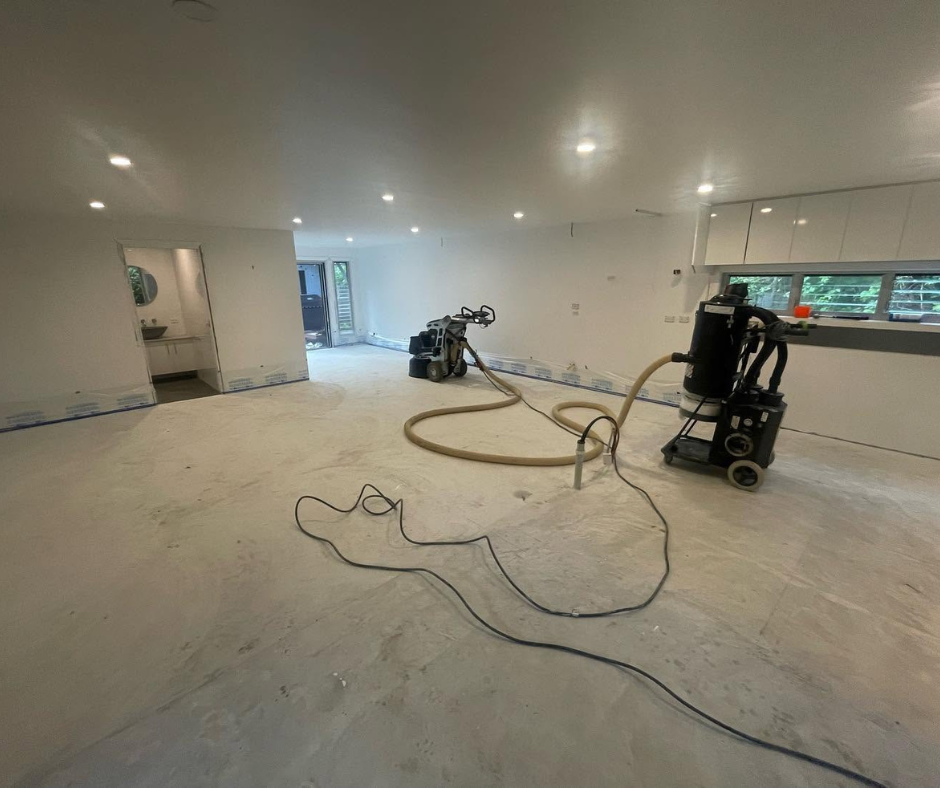
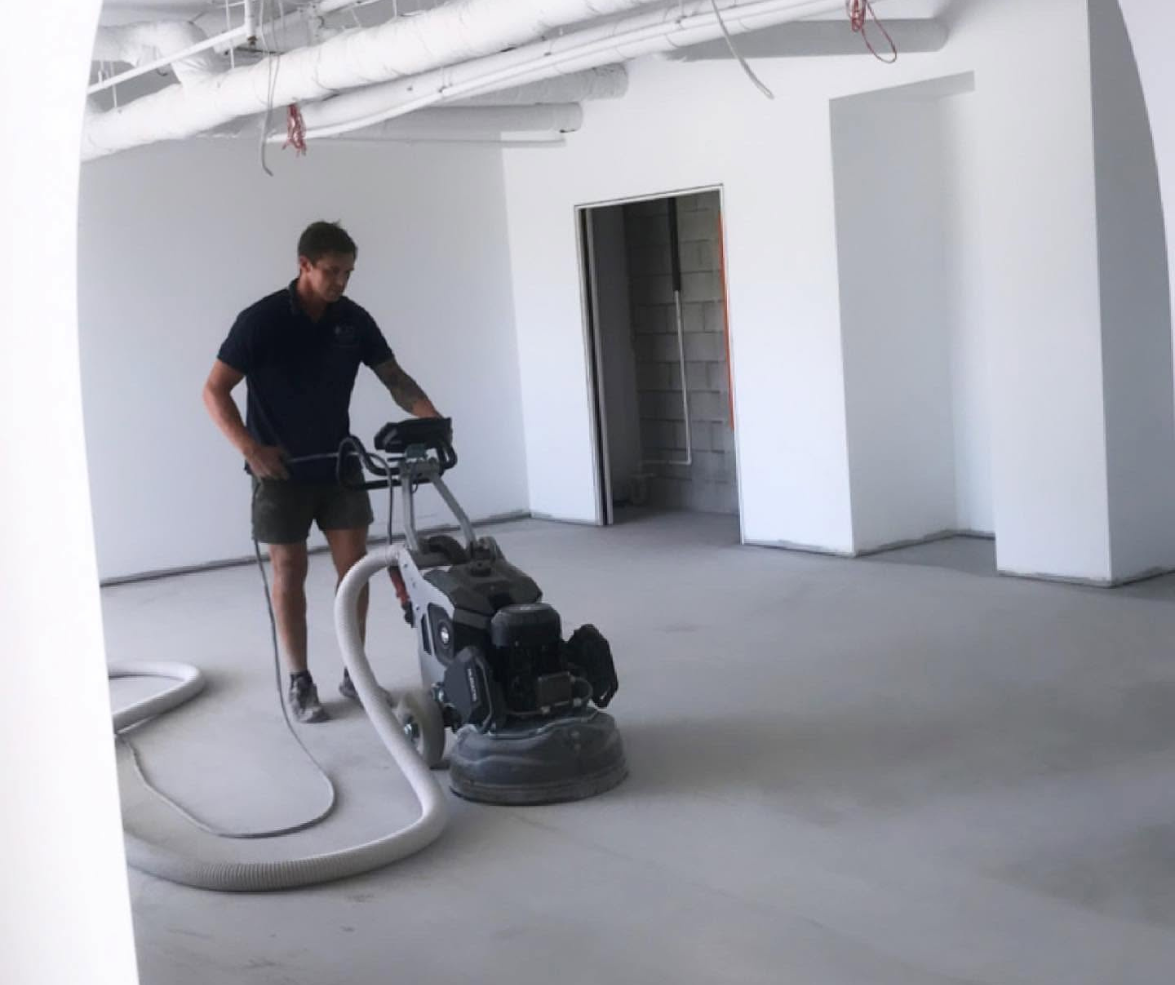
A concrete grinder is a weighted machine that drives diamond segmented tooling across the slab under its own mass. The tooling cuts the bonded material away and takes a thin layer of the concrete surface with it. That second part is what separates grinding from every other method: you finish with fresh, sound concrete rather than a cleaned-up version of the contaminated layer you started with.
Tooling selection does most of the work. Aggressive PCD tooling chews through bulk adhesive and thick coatings quickly, then metal bond diamond grinding segments refine what is left, stepping progressively finer if the slab is heading toward a polish. Skipping the bulk stage and going straight to a fine tool on heavy glue just glazes the segments and burns an hour for nothing.
Always grind a test patch first.
A square metre in an out-of-the-way corner tells us how the material responds, how deep it goes and how the slab underneath is holding up, before we commit a method across the whole floor. It takes twenty minutes, and it has saved plenty of jobs from going the wrong way. For the wider picture, our guide to grinding a concrete floor and why it matters covers the ground in detail.
Dust Extraction Is Not Optional
Grinding concrete dry and unshrouded produces an enormous volume of very fine dust, and that dust contains respirable crystalline silica. The national workplace exposure standard set by Safe Work Australia is 0.05 mg/m³ as an eight-hour time-weighted average, and grinding is named among the processes that generate it. On-tool extraction is one of the engineering controls used to keep exposure under that limit, which is why vacuum-shrouded grinding through HEPA filtration is the standard on Australian sites.
There is a finish quality reason too. Fine dust settling back onto a freshly ground slab contaminates the exact surface the new coating has to bond to. That makes dust control more than a housekeeping issue. See
[Future cluster post: "Dust-Free Concrete Grinding: Why It Matters for Occupied and Indoor Sites", link when live] for a closer look.
Grinding vs the Other Ways to Get Paint & Glue Off a Slab
Grinding is not the only option, and pretending otherwise would be dishonest. Each alternative has a place. The question is whether that place is your floor.
Chemical Strippers & Solvents
Chemical strippers are the usual first thought for paint removal from concrete floor surfaces, and they do soften a lot of coatings. The problem is what happens next. Softened material still has to be scraped off, residue still has to be cleared before anything new goes down, and indoors you are managing ventilation, waste and a slab that has just been soaked in solvent. Results on adhesive are worse again, which is why tile glue almost always ends up under a grinder even when the job starts with a drum of stripper.
Scarifying, Shot Blasting & Water Blasting
Scarifying cuts fast using rotating drums, but it leaves a heavily grooved surface that usually needs grinding afterwards anyway. Shot blasting suits very large open industrial floors, though it cannot get near edges, corners, or anywhere a machine will not fit. High-pressure water blasting works on external concrete and heavy industrial coatings, but it puts a lot of water into a building and leaves a slab that has to dry before anything can be applied.
| Contaminant | Method that suits it | What to expect |
|---|---|---|
| Cement-based tile adhesive | Grinding with PCD tooling | Removes cleanly, leaves slab ready for refinement |
| Soft mastic and pressure-sensitive glue | Grinding, staged tooling | Slower going, tooling needs frequent changes |
| Floor paint and acrylic coatings | Grinding | Fast, though deep penetration can leave shadowing |
| Thick epoxy systems | Aggressive grinding, or shot blasting on large open areas | Labour intensive, worth confirming thickness first |
| Sealers | Grinding | Often invisible until removal starts |
| Waterproofing membrane | Grinding, specialist tooling | Slow, and the substrate underneath needs checking |
| Large open industrial floors | Shot blasting, then grinding at edges | Efficient over area, poor at perimeters |
For a floor that has to end up flat, clean and genuinely ready for a finish, grinding wins because it removes and refines in the same process.
Getting the Slab Ready for What Comes Next
"Ready for a new finish" is not one condition, and this is where jobs quietly go wrong. A slab prepared for polished concrete, a slab prepared for a flake epoxy system and a slab prepared for vinyl planks are three different results from the same starting point.
The variable is surface profile, meaning how open and textured the concrete is once grinding stops. A thin penetrating sealer wants a relatively tight surface. A thick build epoxy wants an open, aggressive texture so the resin has something to key into. Grind past the profile a coating needs, and you have to build it back. Stop short of it, and the coating sits on a surface it cannot grip.
So the finish has to be decided before the preparation is finalised, not after. Once the last pass is done, the slab also needs a clean down, a check for remaining patches under raking light, and repairs to any pitting or cracking that was hiding under the old floor. Understanding the difference between a grind and seal and a full polish helps when you are making that call. To understand what that preparation involves, see
[Future cluster post: "What's Actually Involved in Preparing a Concrete Slab Before Finishing", link when live]
What Can Realistically Be Removed, & What Cannot
Most articles on this topic imply a slab comes back looking brand new. It does not always, and it is better to know that before the machines start than after.
What often stays:
- Oil, grease and chemical staining that has penetrated deep into the concrete
- Colour variation between areas that were covered and areas that were exposed
- Ghosting or shadowing where adhesive or paint has soaked into porous concrete
- Glue driven into pitting, honeycombing and surface voids
- Damage that was hidden under the old floor and only becomes visible once it is off
That last one catches people most often. A slab that has been covered for thirty years has never been looked at, and nobody knows what is under there until it comes up. That same issue shows up in paint removal from concrete floor slabs where the coating has soaked into weak or porous concrete, because grinding lifts the film but cannot reach what has wicked into the material.
When a slab comes up worse than expected, there are three honest paths: grind and coat with a system that hides variation, apply an overlay or concrete resurfacing product to build a new surface, or accept the character of the slab if it is heading toward a polished or grind and seal finish. Our guide on whether all concrete can be polished goes through where that line sits.
Coating Removal on Commercial & Occupied Sites
On a commercial job, the technical side is often the easy part. The constraints are what shape the program.
Retail and hospitality tenancies usually mean working around trading hours or overnight. Occupied offices and strata buildings mean containment, noise management and access negotiated in advance. Live services, tenant belongings and neighbouring businesses all sit within a few metres of the work. And whatever the site, the floor has to be handed over clean enough for the next trade to walk straight onto it.
Sequencing matters as much as method. Coating removal belongs after demolition and before any finishing trade, and getting that order wrong pushes delay through everything downstream. Makegood and fit-out work is where we see it most, because a floor stripped back at the wrong point in the program holds up every trade behind it. For commercial spaces heading toward a resin system, why epoxy works well for commercial flooring is worth a read alongside this, and coating removal is one stage of concrete floor grinding and finishing for commercial and industrial sites more broadly.
[Pillar post - anchor text: "concrete floor grinding and finishing for commercial and industrial sites", link when live]
How a Coating Removal Job Actually Runs
- Site assessment. We identify what is on the slab, how thick it is and what condition the concrete underneath appears to be in.
- Test patch. A small trial area confirms how the material responds before a method gets committed across the floor.
- Containment and extraction set up. Dust barriers, vacuum-shrouded machines and HEPA filtration go in before any grinding starts.
- Bulk removal. Aggressive tooling takes off the volume of adhesive, paint or coating.
- Refinement passes. Progressively finer tooling brings the surface to the profile the next finish requires.
- Repairs. Pitting, cracks and divots exposed during removal get filled and made good.
- Final vacuum and clean down. The slab is cleared of residual dust so nothing contaminates the bond.
- Inspection and handover. We walk the floor with you, confirm it meets what the next stage needs, and hand it over ready to go.
What to Ask Before You Book a Coating Removal Job
Before you accept a quote, these six questions will tell you a great deal about who you are dealing with:
- What method will you use, and why that one for this material?
- What surface profile will the slab be left at, and does it match the finish going down next?
- How is dust being managed, and what containment is included?
- What happens if the slab turns out to be in worse condition than expected?
- Who is responsible for repairing defects exposed once the coating is off?
- What state will the floor be in at handover?
A contractor who has thought the job through will answer all six before the machines arrive. One who has not will answer them afterwards, usually as a variation.
Conclusion
A new floor is only ever as good as the slab underneath it. Everything that goes into choosing a finish, a colour and a system counts for very little if the surface it bonds to still has someone else's glue on it. Getting the removal right is what decides whether the finish lasts or gets redone.
If you have a slab that needs stripping back before a new finish goes down, whether that is a single garage or a full tenancy, get in touch with us, and we will tell you what we are actually looking at. We work across the Gold Coast, Brisbane and Northern NSW, and you can reach us on 0433 512 156.
Key Takeaways
- Coating removal strips bonded material back to sound concrete, which is a different job to cleaning a surface up.
- Grinding removes the contaminant and refines the slab in one process, which is why it suits floors that have to end up flat and ready to coat.
- The material on the slab determines the method, so identifying it correctly is the decision the whole job rests on.
- Leftover adhesive, old sealer and laitance are the most common reasons a brand new coating fails.
- The surface profile a slab needs depends entirely on the finish going down next, so that decision has to come before preparation finishes.
- Deep staining, ghosting and colour variation often cannot be removed at all, and it is better to plan around that than be surprised by it.
Frequently Asked Questions
How do you remove a coating from concrete?
Mechanical removal by grinding is the standard method. The material on the slab gets identified first, then aggressive diamond tooling takes off the bulk of the coating or adhesive, and progressively finer tooling refines the surface to the texture the next finish needs.
Can tile glue be removed without damaging the slab?
Yes, with the right tooling and a controlled approach. Damage usually comes from one of two things: over-aggressive work that gouges the surface, or the wrong method for that adhesive type. Grinding a small test patch first shows how the glue is behaving and how deep it goes, which is what stops the job from going too hard too early. On most floors, removing tile glue from concrete comes down to reading the adhesive before committing to a method.
Will a chemical stripper remove epoxy from concrete?
It can soften some systems, but it rarely removes them cleanly. You are still left with softened residue to scrape and clear, plus solvent handling and ventilation to manage if the work is indoors. On most epoxy floors, grinding is faster, cleaner and leaves a slab that is genuinely ready for the next coating rather than one that needs a second round of preparation.
Does grinding remove paint from concrete completely?
In most cases, yes, because grinding takes a thin layer of the concrete surface along with the paint film. The exception is paint that has penetrated deeply into porous, weathered or poorly finished concrete. There, the film comes off, but shadowing can remain in the material itself, which matters if the floor is heading toward a polished or sealed finish where variation shows.
Do I have to remove the old coating, or can I just coat over it?
Coating over an existing coating is possible in limited cases, but it carries a risk. The new system is only as strong as the bond underneath, so any failure in the old coating can become a failure in the new one. If the existing layer is not sound and compatible, removal is the safer approach.
How long does concrete coating removal take?
It depends on area, material type, thickness, slab condition and access. A single garage with light adhesive is a very different proposition to a tenancy with layered membrane and levelling compound. The honest answer is that a proper site assessment gives you a real timeframe, and a quote given without one is a guess.
What does it cost?
Pricing is driven by the area involved, the type and thickness of what has to come off, the condition of the slab underneath, site access, how much dust containment is required, and the finish going down afterwards. Two floors of identical size can price very differently on those factors alone. Our decorative concrete cost guide walks through how project costs are built up.
Is coating removal dusty, and can it be done in an occupied building?
It can be done in occupied buildings, and it is done that way regularly. Vacuum-shrouded grinders running through HEPA filtration capture the dust at the tool rather than letting it into the air, which is what makes work in tenanted offices, trading retail spaces and lived-in homes practical. Containment barriers and staged access handle the rest.
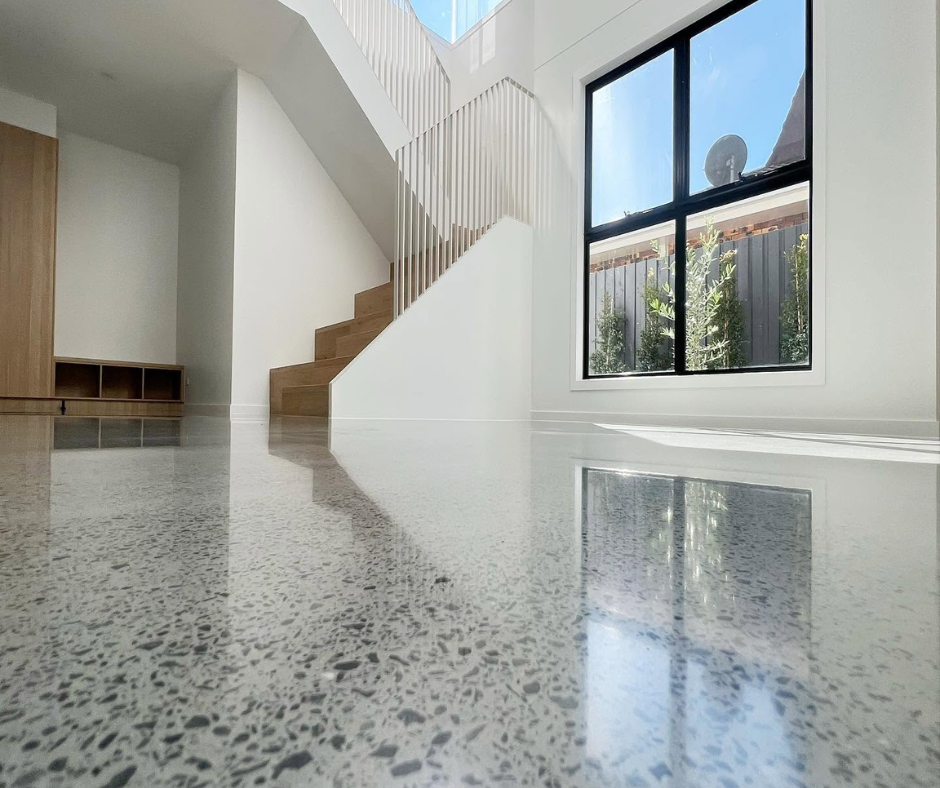
Can a slab be polished after tile adhesive has been ground off?
Sometimes, and it depends on what the removal reveals. Slab quality, aggregate distribution, previous patching and how deeply the adhesive penetrated all affect whether a polished result is achievable and what it will look like. This is one to assess honestly on site rather than assume, because a polished finish shows everything a coating would hide.
What happens if adhesive is left behind before a new floor goes down?
The consequences depend on the finish. Under resilient flooring, ridges telegraph through as visible lines. Under a coating, the bond fails wherever the contaminant sits. Under tiles, high spots stop the bed from sitting flat. In every case, the fix means pulling up a brand new floor to correct something that should have been dealt with before it went down, which is always more expensive than doing the removal properly the first time.